
Why Gladys Presley Could Never Let Elvis Go
Gladys Presley’s love for her son Elvis was fierce, constant, and instinctively protective. It was not the kind of love shaped by comfort or ease, but one forged in hardship, loss, and uncertainty long before fame ever entered their lives. From the moment Elvis was born, Gladys carried within her an unshakable fear of losing him—a fear that never truly faded, no matter how bright his future became.
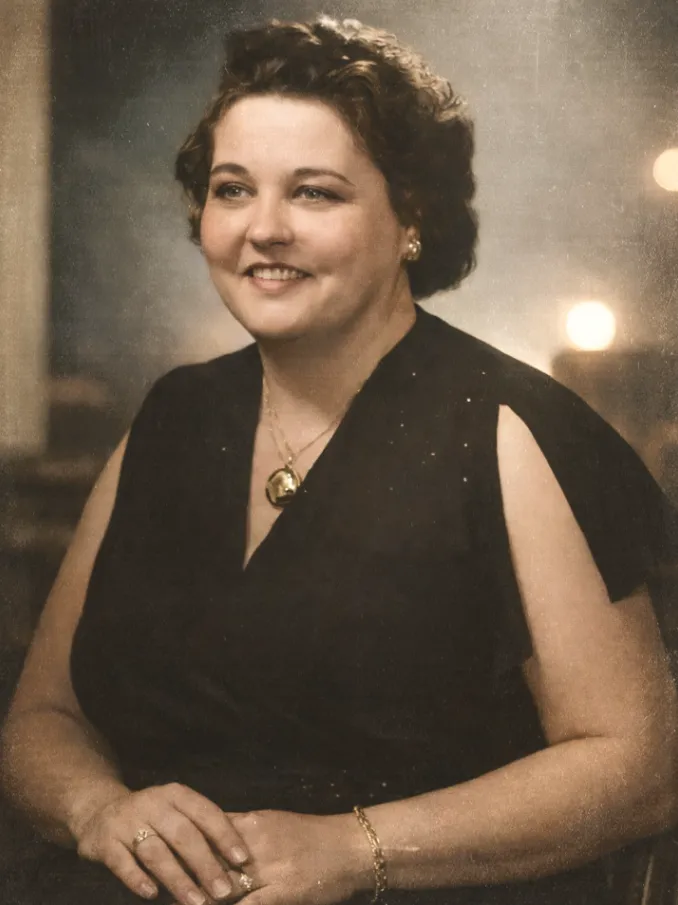
That fear had deep roots. Before Elvis took his first breath, Gladys had already endured loss that would mark her forever. When Elvis’s twin brother was stillborn, the joy of motherhood arrived hand in hand with grief. From that moment on, Elvis was not simply her child—he was the one she had left. And so she held on to him with a devotion that was total, protective, and all-encompassing.
As a child, Elvis was rarely out of her sight. They shared the same bed until he was thirteen, not out of indulgence, but out of closeness and reassurance. He did not spend a night away from home until he was seventeen. Years later, Elvis would speak about this matter-of-factly, without embarrassment or resentment. His mama never let him out of her sight, he said simply—and he never seemed to mind. To him, her presence meant safety. It meant belonging. It meant home.
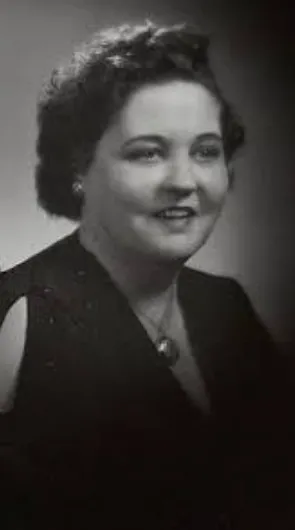
Gladys was not a woman of grand gestures or flowery words. Her love showed itself in vigilance—in watching, worrying, and staying close. She listened carefully to Elvis’s moods, sensed his vulnerabilities, and worried about the world’s ability to treat him gently. Even before fame arrived, she understood that her son was different—sensitive, impressionable, deeply emotional. She feared that the same qualities that made him special could also leave him exposed.
That bond, so tightly woven, faced its greatest test in December 1957, when Elvis received his military draft papers. By then, his fame was exploding at a speed no one could fully comprehend. The boy Gladys had protected so fiercely was now a global phenomenon. Crowds screamed his name. The world claimed him. And now, the Army was calling him away.
For Gladys, the thought was devastating.
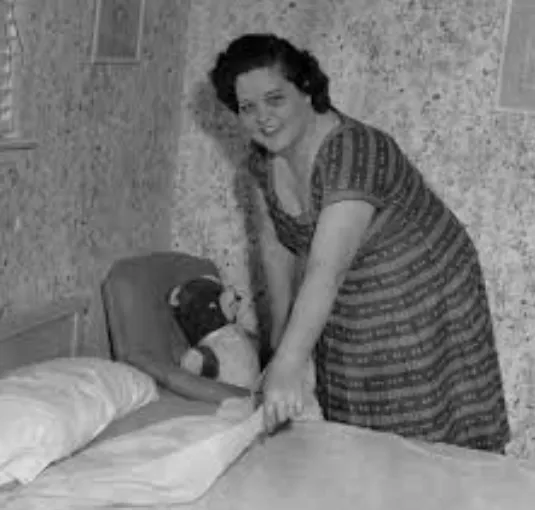
Elvis had always been close. Always reachable. Even as fame surrounded him, she knew where he was. She could see him, touch him, worry over him. But military service meant distance, danger, and uncertainty. It meant losing the ability to protect him. Friends later recalled how deeply shaken she was during that time—how anxious, how withdrawn. It was as if she sensed that something precious and fragile was slipping beyond her control.
Her fear was not irrational. It was maternal intuition shaped by a lifetime of loss and struggle. And though Elvis faced his service with courage and duty, the separation weighed heavily on both of them.
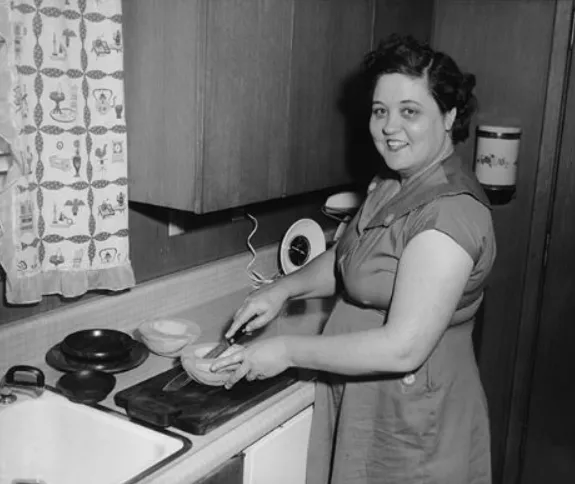
By that point, Elvis had already purchased Graceland, and the family’s life had transformed in ways few could imagine. They moved from poverty into luxury almost overnight. The house was large, elegant, and filled with symbols of success. But for Gladys, those changes never altered who she was at her core.
Elvis lavished her with gifts, eager to give her everything she had once gone without. Among them was a pink Cadillac—a symbol of his success and his love. Yet she never learned to drive it. Instead, she clung to the habits shaped by years of scarcity. She wore simple dresses and repaired them herself, the stitching visible, the fabric worn but lovingly cared for. She did not replace things simply because she could. Money, to her, did not erase memory.
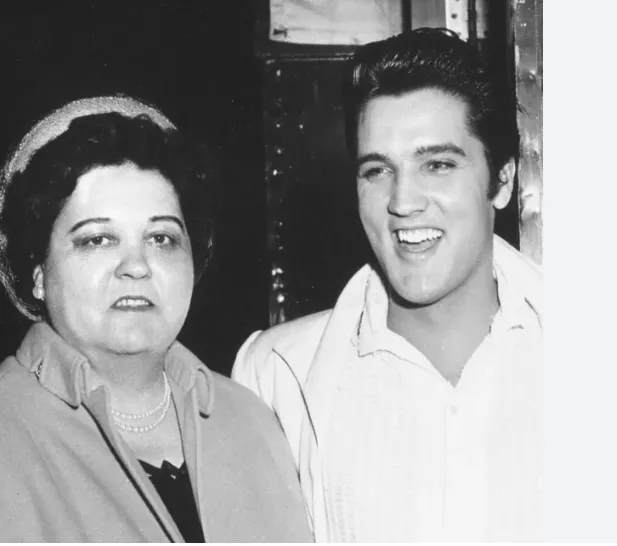
The Great Depression had taught her lessons that abundance could not undo. She knew what it meant to have nothing. She knew the fear of not knowing how tomorrow would be paid for. And those lessons stayed with her, even as her surroundings changed.
That same mindset lived on in Vernon Presley.
Vernon kept everything—every bill, every letter, every scrap of paper that passed through Graceland. To outsiders, it may have seemed unnecessary or peculiar. But to those who understood the Presley family history, it was not eccentricity. It was survival memory. Saving everything had once been the difference between getting by and going without. When you have lived on the edge of nothing, you never fully trust abundance.
Even when life improved, those instincts remained.
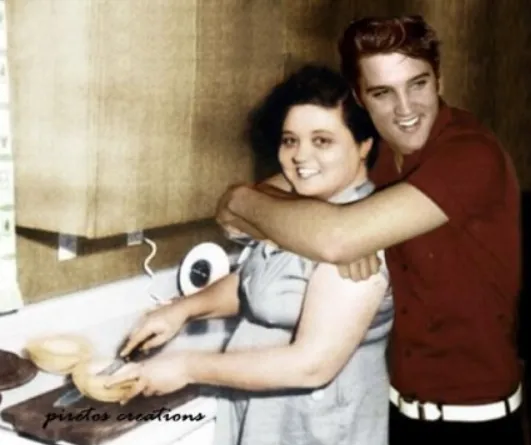
Together, Gladys and Vernon carried the past with them—not as bitterness, but as awareness. And that awareness shaped Elvis profoundly. He grew up knowing both love and lack, both devotion and fear. He understood gratitude not as a concept, but as a lived experience.
Gladys’s devotion and resilience shaped Elvis more than any stage or spotlight ever could. Her love gave him tenderness. Her fears gave him sensitivity. Her struggles gave him humility. Long after her passing, her influence remained woven into every part of his life.
It lived in his music—in the vulnerability of his voice, the ache beneath the power. It lived in his generosity—in the way he gave without calculation, remembering what it felt like to need. It lived in his emotional openness, his longing for reassurance, his deep attachment to the idea of home.
She was not just his mother.
She was his anchor.
And in many ways, she was the quiet heart behind the man the world came to love. Fame made Elvis visible, but love made him who he was. Long after the applause faded and the lights dimmed, the imprint of Gladys Presley’s love remained—steady, protective, and unforgettable.
A Silence That Spoke Louder Than Any Song: Riley Keough at Elvis Presley’s Grave
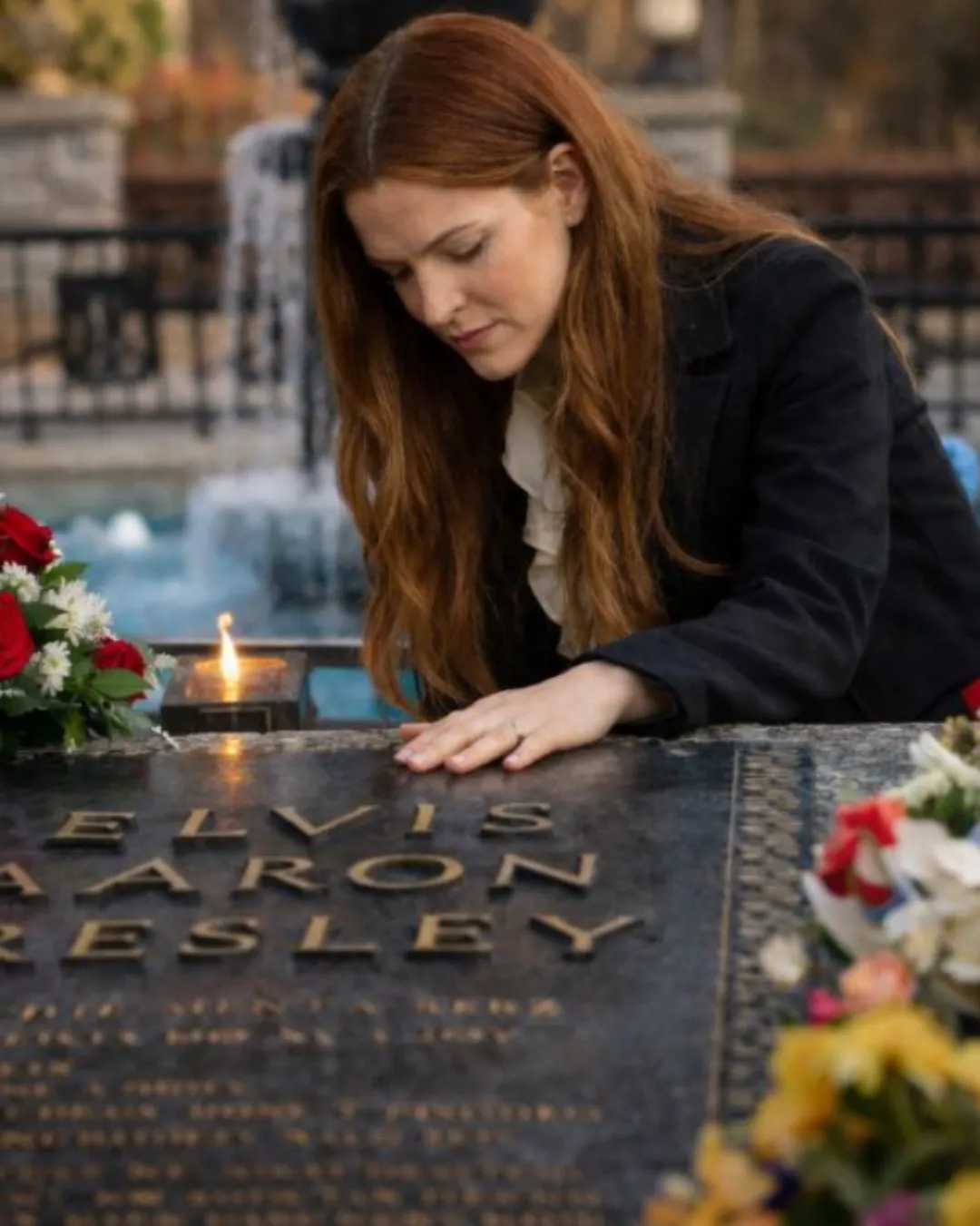
Earlier today, Riley Keough was seen standing alone at Elvis Presley’s grave. There were no cameras raised in her direction, no entourage hovering nearby, no attempt to turn the moment into something public. Just a woman, a grave, and a silence so deep it seemed to press gently against the air itself.
Those who happened to witness it said she didn’t rush. She didn’t pose. She simply stood there, one hand resting on the cool marble, her posture still, her face carrying an emotion that needed no explanation. In that quiet moment, the Presley legacy felt stripped of spectacle. It was no longer about the King of Rock and Roll, the icon, the myth. It was about family.
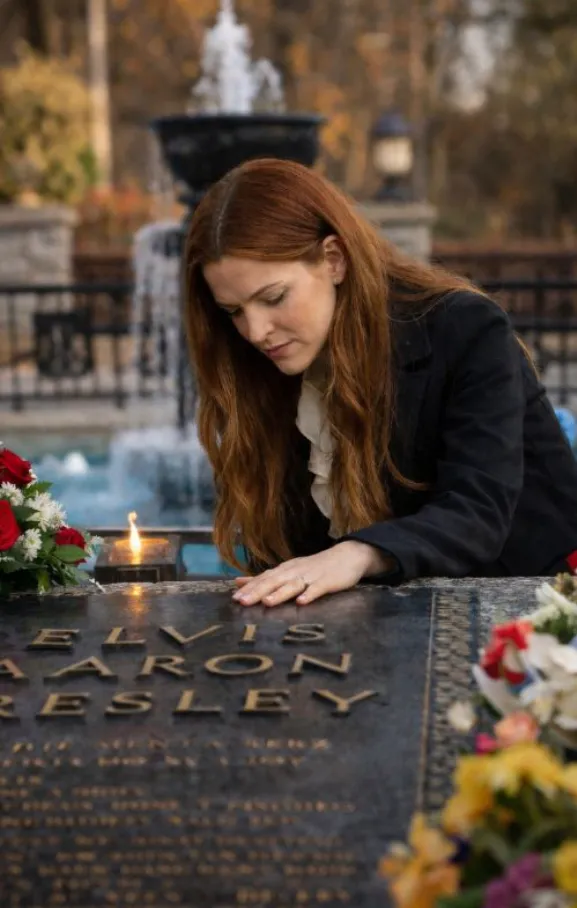
Silence has always played a strange role in the Presley story. Elvis was one of the loudest cultural forces the world has ever known—his voice, his performances, his impact impossible to ignore. And yet, the most powerful chapters of his life were often the quietest: the private griefs, the moments of longing, the bonds that existed far from the stage lights. Standing at his grave today, Riley Keough seemed to step directly into that quieter lineage.
Riley is often described by the media as Elvis Presley’s granddaughter, but that label barely scratches the surface of what the name means to her. She is also the daughter of Lisa Marie Presley, a woman whose entire life unfolded beneath the long shadow of an extraordinary legacy. Riley grew up not just knowing the story of Elvis, but living with its weight—its beauty, its pressure, and its unspoken sorrow.
At the grave, none of that needed words.
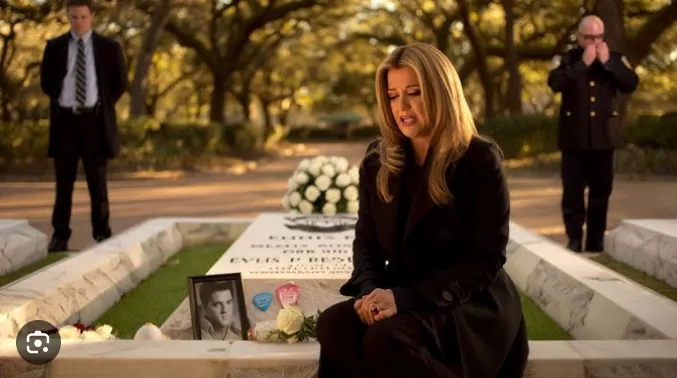
Observers said the autumn light was soft, almost tender, filtering down as Riley stood motionless. She didn’t wipe tears. She didn’t speak. Her stillness felt deliberate, as if she were listening rather than mourning. Listening to memory. Listening to history. Listening to something only family can hear.
In moments like this, the Presley legacy stops being a timeline of albums, awards, and headlines. It becomes something much smaller and much heavier: a name carved in stone, a lineage marked by love and loss, and the quiet understanding that fame does not protect anyone from grief.
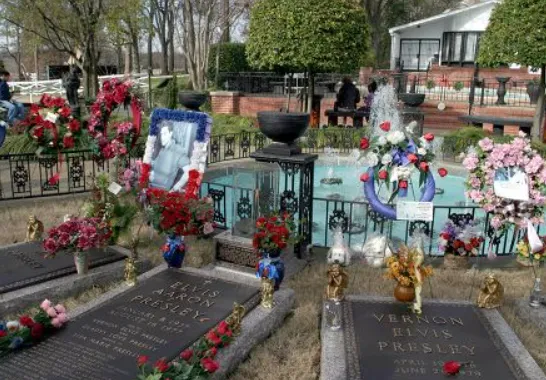
Elvis Presley’s grave has been visited by millions. Fans come from all over the world, leaving flowers, letters, and whispered thank-yous. For them, Elvis is a symbol—a voice that shaped generations, a presence that changed music forever. But for Riley, the man beneath the marble is not a symbol. He is a grandfather she never had the chance to know, a presence felt through stories, recordings, and the emotional echoes passed down through her mother.
That distance—between legend and blood—is one of the most complex aspects of the Presley inheritance. Riley did not grow up with Elvis’s hand guiding her, yet his absence shaped her life just as profoundly as his presence shaped the world. Loss has a way of doing that. It becomes something inherited, something felt even without memory.
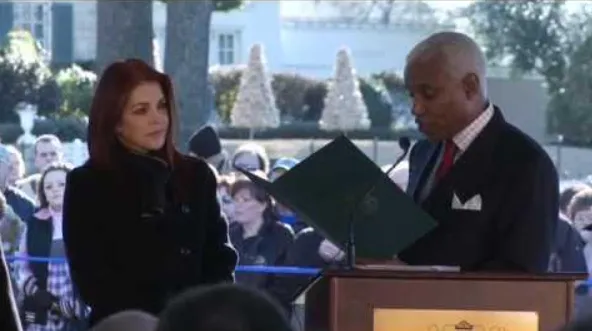
When Lisa Marie Presley passed away, that inheritance shifted again. Riley became not just a granddaughter of Elvis, but a living bridge between generations—between a past defined by overwhelming fame and a present marked by quieter endurance. Standing at the grave today, she seemed to embody that role without effort. Not as a representative of a legacy, but as a daughter who has lost a mother, and a granddaughter standing before a name that has defined her family’s story for decades.
What struck witnesses most was how ordinary the moment felt—and how profound that ordinariness was. There was no ceremony, no announcement, no attempt to frame the visit as meaningful. And yet, it was meaningful precisely because it wasn’t framed at all.
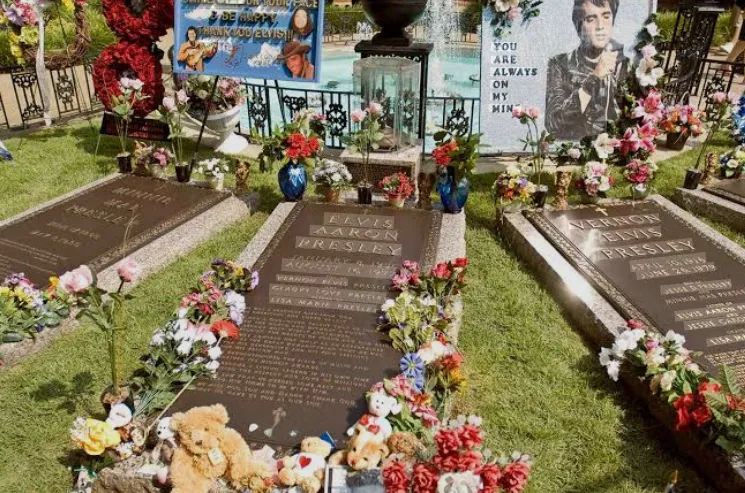
In that stillness, the noise that has always surrounded the Presley name seemed to fall away. No expectations. No mythology. Just a human connection that doesn’t need explanation.
Elvis once sang songs that captured longing, heartbreak, devotion, and loneliness with uncanny precision. His voice had a way of filling space, of making emotion feel immediate and shared. But standing at his grave, Riley didn’t need sound. The silence carried everything his music once held: love, loss, and the ache of what cannot be recovered.
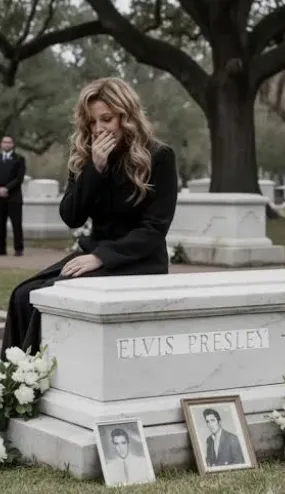
There is something quietly powerful about grief when it isn’t performed. When it exists without an audience, it becomes honest in a way nothing else can. Riley’s presence today felt like that kind of honesty—unfiltered, unguarded, and deeply personal. She wasn’t there to remember a public figure. She was there to acknowledge a bond written not in memory, but in blood.
The Presley story has always been told in extremes: explosive fame, overwhelming adoration, tragic loss. But moments like this reveal the softer truth beneath it all. That no matter how large a name becomes, it still belongs to a family. That behind every legend is a line of people who carry its weight quietly, long after the world has moved on to the next headline.

As Riley eventually stepped away, there was no dramatic ending. No final gesture. Just the slow, natural conclusion of a moment that never needed to be seen to matter. The grave remained. The silence returned. And the legacy continued—not as noise, but as something deeply felt.
This episode isn’t about spectacle. It isn’t about celebrity. It’s about what remains when the world stops watching.
A granddaughter standing alone.
A name carved into stone.
And a silence so full it feels like a song the heart remembers—even when no one speaks.